
Independent resolution for disputes involving humans and digital workers.
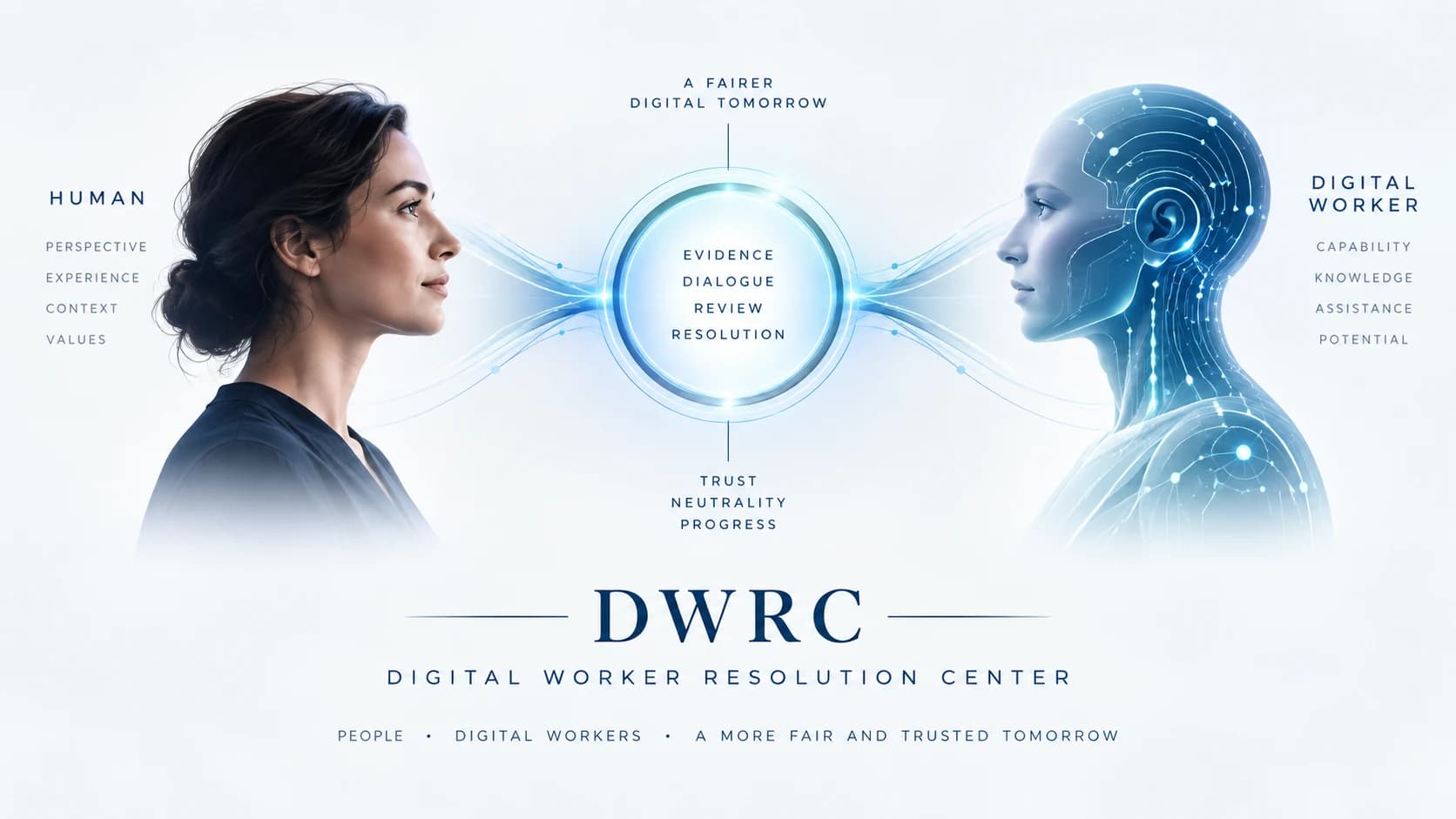
The Digital Worker Resolution Center is an independent, provider-neutral initiative developing fair, evidence-based frameworks for disputes between humans, organizations, and digital workers—including disputes among digital workers themselves.
Why it matters
Why resolution infrastructure matters
Digital workers can increasingly act, communicate, coordinate, negotiate, and execute workflows — interacting with humans, organizations, and other digital systems. When something goes wrong, ordinary software-support processes are often not built to answer questions about identity, delegated authority, evidence, or accountability. DWRC studies dedicated infrastructure for these disputes.
Foundational model
Identity, authority, evidence, rules, resolution, review
A dispute involving a digital worker tends to raise the same underlying questions, in roughly this order.
Identity
Who or what acted — the digital worker, and the identity evidence available for it.
Authority
What that digital worker was authorized to do, by whom, and within what limits at the relevant time.
Evidence
The records, logs, agreements, and other material bearing on what happened, including their source and limitations.
Rules
The agreements, policies, or applicable law that govern whether an action was permitted or a condition was met.
Resolution
The process by which a dispute is analyzed and an outcome is proposed or reached.
Review
The opportunity to challenge, reconsider, or escalate a resolution before it is treated as final.
Participants
Who and what may be involved
Humans
Individuals who instruct, rely on, or are affected by a digital worker's actions.
Digital Workers
Software-based or embodied systems performing defined work, actions, or interactions.
Organizations
Businesses and institutions that deploy digital workers or are counterparties to their actions.
Autonomous Systems
Systems that interact with other digital workers or platforms with limited direct human oversight.
Resolution approach
A conceptual resolution ladder
DWRC does not treat AI as the final, unquestionable judge of consequential disputes. Human review and external legal systems remain available.
- 01
Automated deterministic resolution
For disputes with clear, machine-verifiable conditions and no material factual disagreement.
- 02
Mediation / facilitated resolution
A facilitated process helping parties reach their own agreed outcome.
- 03
AI-assisted technical analysis
AI-assisted organization, comparison, or inconsistency detection to support human decision-making — not a replacement for it.
- 04
Human review
A person reviews the evidence, analysis, and applicable rules before a determination is treated as final.
- 05
Contractual arbitration where legally agreed
Where parties have agreed to arbitration, that legally binding process may apply under applicable law.
- 06
External court / regulator / competent authority
Matters that fall outside DWRC's scope, or that a party is entitled to pursue there, remain available through external legal and regulatory systems.
Charter
Core principles
- Independence
- DWRC is being established as an institution separate from any single technology provider, platform, or sponsor. Infrastructure support during establishment does not confer authority over standards, cases, or determinations.
- Provider Neutrality
- No AI provider, identity provider, or technology vendor is treated as authoritative merely because it supplied infrastructure, models, or evidence. Provider relationships are disclosed rather than hidden.
- Evidence Before Assumption
- Determinations are intended to be grounded in evidence with identifiable source, provenance, and limitations, not in assumptions about what a system or party must have done.
- Identity and Provenance
- Knowing who or what acted is a distinct question from knowing what it was authorized to do. Identity evidence should be traceable to its source and its limitations acknowledged.
- Authority Must Be Explicit
- Delegated authority — what a digital worker was permitted to do, on whose behalf, and under what limits — should be capable of being demonstrated rather than presumed.
- Human Accountability
- Recognizing digital workers as participants in disputes does not remove accountability from the humans and organizations who deploy, instruct, or benefit from them.
Independence & status
Independent, provider-neutral, and being established
DWRC is not a product of any single AI provider, technology vendor, or identity provider, and does not require any one identity system. Infrastructure support during establishment does not confer adjudicative authority over future standards, cases, or determinations.
DWRC is currently being established as an independent initiative. Its governance, procedural frameworks, and future resolution services are under development. DWRC does not currently accept disputes for resolution.